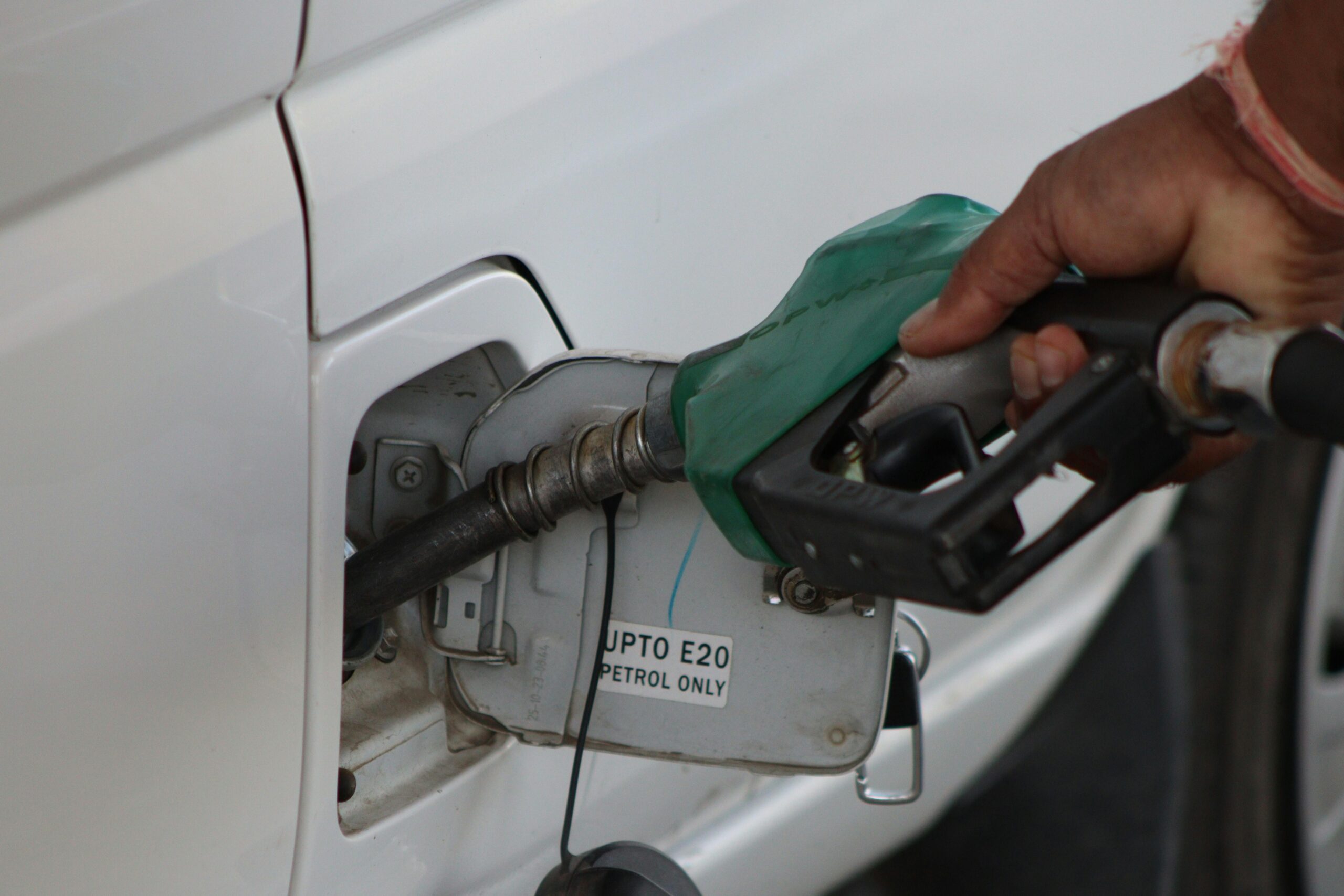
The UAE Fuel Price Committee, which benchmarks domestic fuel costs against global crude markets each month, has announced a significant upward revision for April 2026. Both petrol and diesel grades will see sharp increases beginning Wednesday, April 1 — with diesel recording what is almost certainly its most dramatic single-month adjustment in the country’s recent history.
The revisions are directly tied to a surge in global crude oil prices, which have climbed to the $115–$120 per barrel range over the past several weeks amid renewed geopolitical tensions across the broader Middle East. For motorists, fleet operators, and logistics businesses, the numbers are stark, and the timeline is immediate.
“Diesel has effectively leapt by nearly two dirhams per litre overnight — an increase that will reverberate through logistics, construction, and every sector that moves goods by road.”
Industry impact overview
The Diesel Anomaly
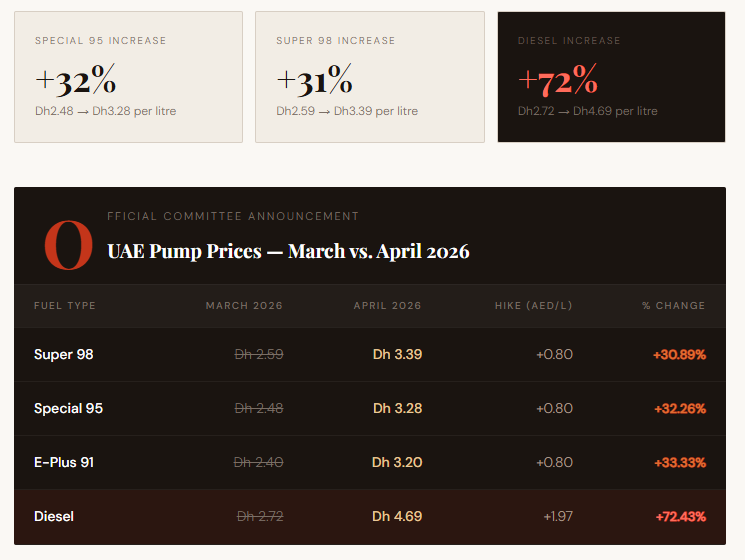
While the across-the-board Dh0.80 increase for all three petrol grades is significant — representing a roughly 30–33% step up depending on the grade — it is diesel’s trajectory that commands attention. A rise of Dh1.97 per litre, pushing the price from Dh2.72 to Dh4.69, represents a 72.43% increase in a single monthly revision. This is not a rounding error or a gradual trend: it is an abrupt repricing that will be felt immediately across the logistics and transport sectors.
Diesel powers heavy goods vehicles, generators at construction sites, agricultural machinery, and the long-haul trucks that underpin supply chains across the Emirates. Companies operating fleets will need to revise their cost projections quickly. Operators running 40-litre refills daily, for instance, will see fuel costs rise by roughly Dh78 per vehicle per day — before accounting for any downstream adjustment in freight tariffs.
Global ContextCrude oil prices have climbed into the $115–$120 per barrel range in recent weeks, driven by heightened geopolitical tensions in the Middle East. This represents a substantial increase from the $85–$90 levels seen in the closing months of 2025.
The UAE, which prices fuel in alignment with global benchmarks, adjusts pump prices monthly through a committee-led mechanism introduced in 2015 — designed to pass market realities directly to consumers rather than sustaining subsidies.
Impact Across Sectors
For everyday drivers, the practical effect is straightforward: refilling a standard 50–60 litre tank will cost roughly Dh40 to Dh60 more than it did in March. Those driving regularly between emirates — say, Abu Dhabi to Dubai and back — will notice a cumulative difference within their first week.
Who Feels This Most
- Logistics & freight companies — diesel-dependent fleets face immediate cost pressure on every route
- Ride-hailing & taxi drivers — operating margins will tighten unless fare structures are revisited
- Construction firms — site generators and heavy equipment run on diesel around the clock
- Long-distance commuters — those driving 200km+ per week will see noticeable monthly increases
- SMEs with delivery operations — last-mile delivery costs will require urgent recalculation
For the broader economy, sustained high fuel prices typically feed into transportation costs, which in turn affect the price of goods at the retail level. Whether this becomes an inflationary pressure depends significantly on how long crude prices remain elevated and whether subsequent monthly revisions temper or compound today’s increase.
What You Should Do Now
The most immediate, practical action available to any motorist today is to refuel before midnight on March 31. March prices remain in effect until the pump rollover at the start of April 1. With a difference of Dh0.80 per litre on petrol and nearly Dh2.00 per litre on diesel, the savings on a single full tank are material, ranging from Dh40 to as much as Dh100 depending on vehicle capacity and fuel type.
Practical adviceFill up at any station before midnight tonight (March 31) to pay March rates. For a standard 60-litre petrol tank, this saves approximately Dh48. For diesel vehicles, the saving on a single refill could exceed Dh100.
Beyond the immediate refill opportunity, this is a prudent moment for businesses to review fuel budgets, renegotiate logistics contracts where possible, and consider whether vehicle mix or route optimisation can offset some of the cost impact. For individuals, it may be worth revisiting how frequently refills are needed and whether habits like idling or short cold-start trips can be reduced.
Looking Ahead
The May 2026 pricing announcement, expected in late April, will be closely watched. If global crude softens — as it historically does when geopolitical tensions ease — the committee could revise prices downward. But with current market conditions showing no immediate sign of relief, motorists and businesses would be prudent to plan for elevated fuel costs through at least the near term.
The UAE’s deregulated fuel pricing model means that Emiratis and residents experience global energy market movements directly, without the buffer of subsidies. This transparency cuts both ways: the same mechanism that delivers lower prices when crude falls also delivers the increases we are seeing today, without delay.
For now, the message is clear: fuel in the UAE is more expensive than it has been in recent memory. Adjust your plans, review your budgets — and if you haven’t filled up yet, there are still a few hours left to do so at March rates.